

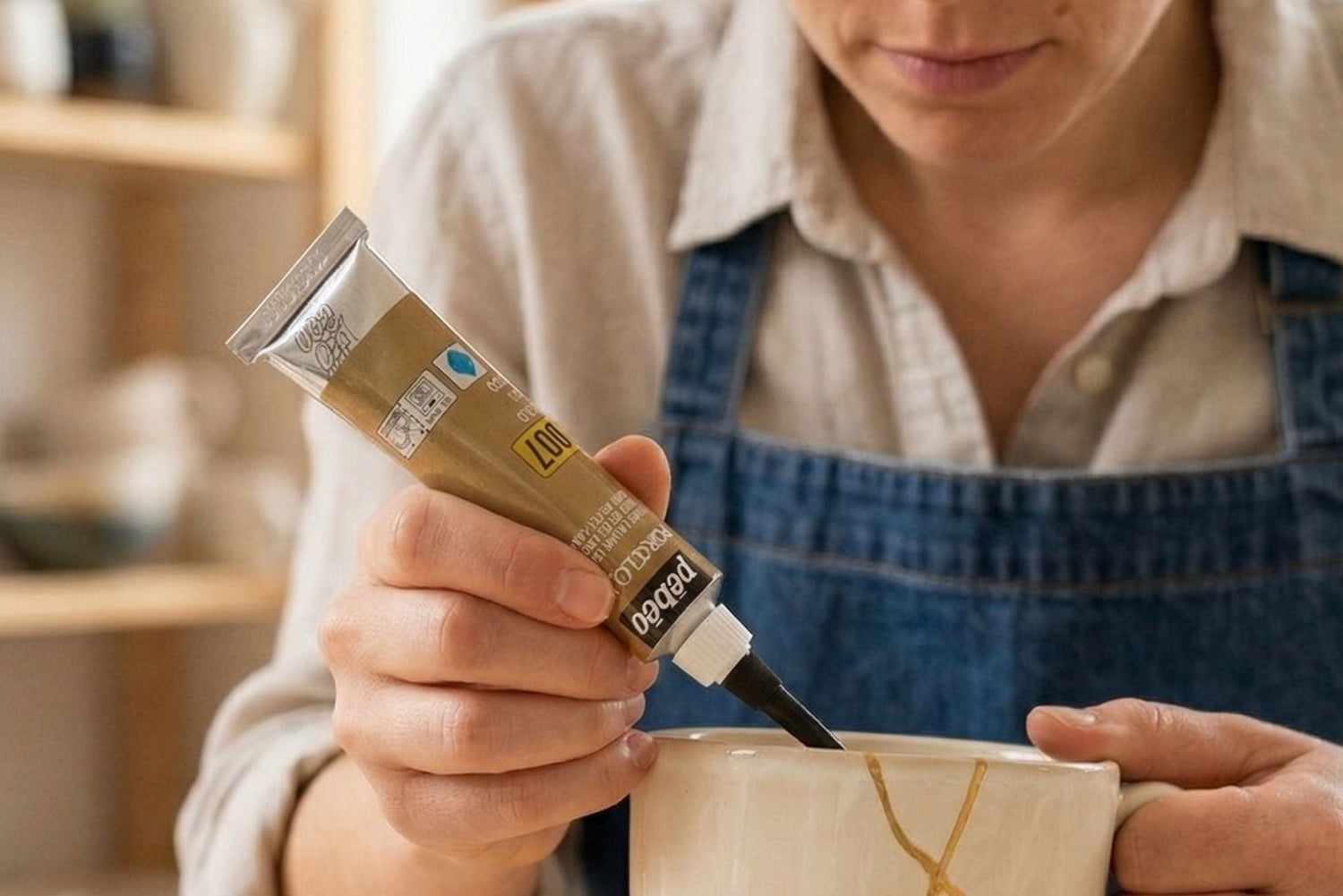

Cracked dishes or chipped mugs — too precious to throw away, yet traditional kintsugi seems out of reach. If you've been considering kintsugi-style DIY using Porcelaine 150, you're not alone.
Porcelaine 150 is a water-based acrylic paint for ceramics made by the French art supply brand Pebeo. Its gold-colored outliner type closely resembles the lines of kintsugi, which is why it has spread through social media and personal blogs as a material for "kintsugi-style DIY."
At ANYTSUGI, we regularly receive inquiries along the lines of: "I repaired my dish with Porcelaine 150 — is it safe to keep using it?" This article is our honest answer to that question.
Our Conclusion: Porcelaine 150 Kintsugi-Style DIY Is Not Recommended for Use on Tableware![]()

Let me share my conclusion upfront.
We do not recommend using Porcelaine 150 to repair dishes intended for everyday use.
There are three main reasons for this.
Reason ① Food Safety Is Not Guaranteed
Porcelaine 150 carries the AP mark — a safety certification under the U.S. ACMI standard. It's easy to assume this means the product is food-safe, but that assumption is incorrect.
The AP mark indicates that "the product does not contain ingredients known to cause chronic health hazards" — in other words, it certifies safety as an art material. It is not a safety standard designed for contact with food or the mouth.
The AP mark does not cover the risks of applying acrylic paint to the rim of a cup or to surfaces that come into direct contact with food and using them on a daily basis.
Reason ② Risk of Peeling and Wear
While baking Porcelaine 150 in an oven improves adhesion, everyday use — including dishwashers, sponge washing, and exposure to food acids — can gradually cause the coating to wear and peel. The risk of microscopic paint particles mixing into food cannot be ruled out entirely.
Reason ③ Pebeo's Official Stance: "Not Recommended"
In Pebeo Japan's official FAQ, the company states that it recommends avoiding painting on areas that come into contact with the mouth or food as much as possible.

Source: Pebeo Official Website
In other words, the manufacturer itself does not recommend it. Many blog articles promoting kintsugi-style DIY with Porcelaine 150 fail to mention this — so please be aware.
How Does It Compare to Authentic Kintsugi?
Here's a side-by-side comparison of kintsugi-style DIY using Porcelaine 150 and authentic kintsugi.
To be honest, putting this table together reminded me just how appealing Porcelaine 150 is. The fact that you can achieve a kintsugi-like look with a single tool for just a few hundred yen is real. But that's exactly why I want to make sure the right information is out there.
|
Criteria |
Porcelaine 150 (Kintsugi-Style) |
Authentic Kintsugi (Natural Urushi Lacquer) |
|---|---|---|
|
Material |
Adhesive + water-based acrylic paint |
Natural urushi lacquer + gold powder |
|
Food Safety |
Not recommended |
Safe |
|
Dishwasher |
Not recommended – use with caution |
Not recommended |
|
Durability |
Low (risk of peeling) |
High |
|
Difficulty |
Low |
Moderate |
|
Cost |
A few hundred to a few thousand yen |
Several thousand to tens of thousands of yen |
|
Use on Everyday Tableware |
Not recommended |
Safe for everyday use |
① Material: Water-Based Acrylic vs. Urushi Lacquer
Porcelaine 150 is an acrylic-based paint. Natural urushi lacquer, used in authentic kintsugi, forms an extremely hard coating once cured and has been used for centuries in the finishing and restoration of ceramics. The track record on food safety is in a completely different category.
It's also worth noting that Porcelaine 150 only works as a surface coating — it has no adhesive strength to bond broken pieces back together. If you want to use a repaired dish again, you'll need a separate adhesive (ideally one with food-safe properties, such as Titebond), and then apply Porcelaine 150 over the joint.
② Food Safety
As mentioned above, the food contact safety of Porcelaine 150 is unclear. Natural urushi lacquer, on the other hand, is considered safe for contact with food once cured, and has a long history of use in coating and restoring tableware.
③ Durability and Longevity
Acrylic coatings are not resistant to the wear of everyday use. With repeated use as tableware, peeling may occur within months to a few years. Authentic kintsugi, when properly finished, can withstand long-term use.
④ Cost and Difficulty
Porcelaine 150 is easy to get started with at a low cost — just a few hundred yen — while kintsugi kits tend to be more expensive, around 10,000 yen.
Kintsugi does require more skill than simply applying Porcelaine 150, but here's something I want to be clear about: kintsugi is not a highly advanced craft that only professionals can do. Even beginners can achieve surprisingly good results by following the steps carefully.
If You Want to Repair Your Dishes, Consider Kintsugi
Personally, if you're worried about the safety of Porcelaine 150 but still want to repair your dishes, I'd genuinely encourage you to give kintsugi a try. The quality of the finish is in a completely different league.

Kintsugi with natural urushi lacquer is a traditional Japanese technique in which cracks and chips are bonded and filled with lacquer, then finished with gold powder. Once cured, urushi has high food safety properties, and a properly finished piece can be used as everyday tableware for many years to come.
Recently, it has also gained popularity as a digital detox activity and a fulfilling hobby for adults.
At ANYTSUGI, we carry kintsugi kits designed for beginners. If you want to use your repaired dishes with peace of mind, take a look below.


Leave a comment
This site is protected by hCaptcha and the hCaptcha Privacy Policy and Terms of Service apply.