

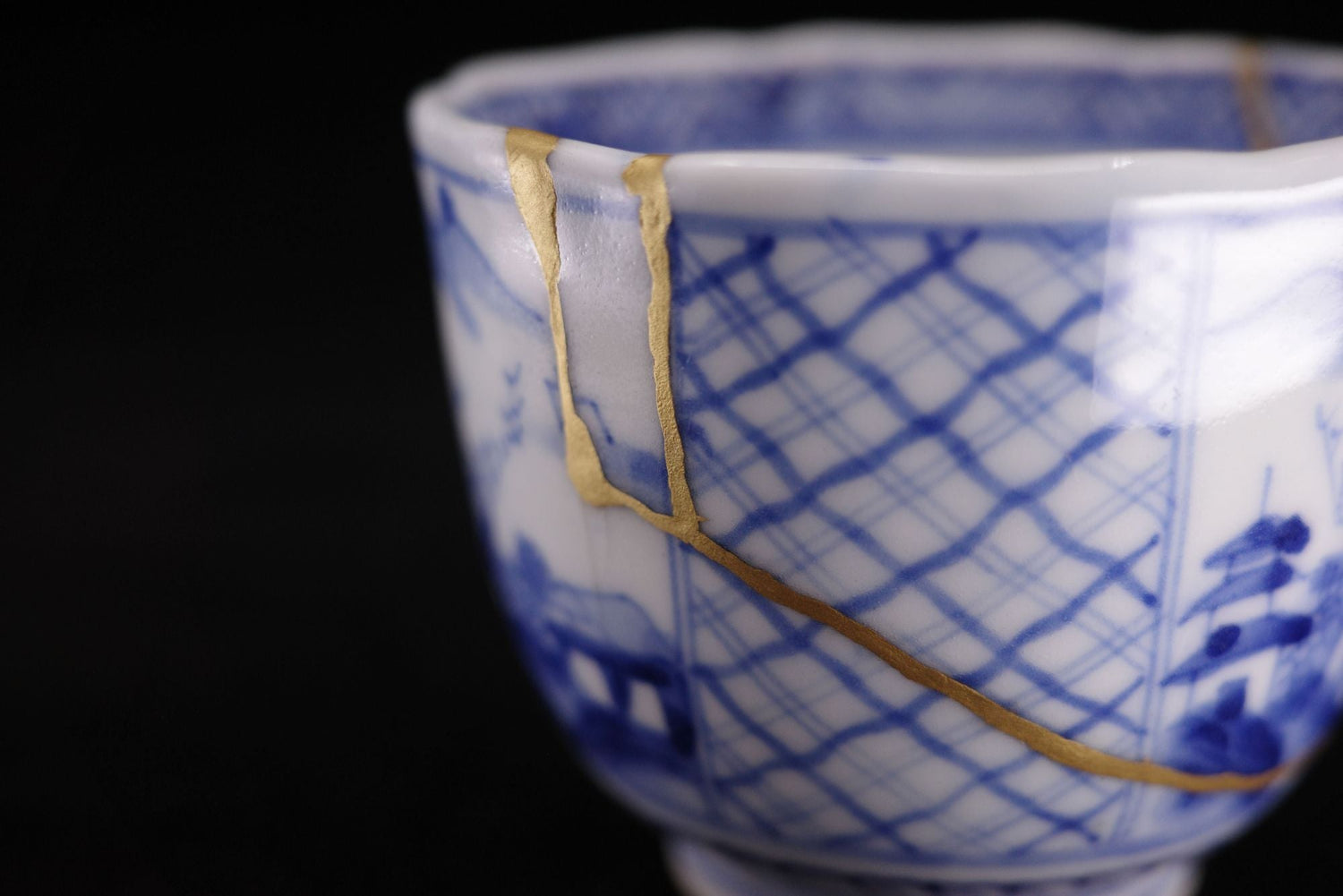

Think of a moment when something in your life broke.
A relationship. A dream you'd chased for years. Or that quiet realization that things would never go back to how they were. Most of us try to hide those cracks. Pretend they never happened. Rush back to who we were before.
But what if those very cracks are what make you deeper — and more beautiful?
Over 500 years ago, Japan gave us "kintsugi" — a technique for repairing broken pottery with gold. Instead of hiding the damage, it highlights it. That one radical idea is quietly but powerfully changing hearts all around the world.
We started ANYTSUGI because we wanted to bring this philosophy to more people. One day, a traveler came all the way from overseas just to pick up a kit in person. That moment hit us: kintsugi isn't just Japan's anymore. In this article, we'll unpack what "kintsugi meaning in life" really means — from the perspective of people who make and use these kits every day.
What Is Kintsugi? The 500-Year-Old Art That Changes Everything

"Kintsugi" comes from two Japanese words: "kin" (gold) and "tsugi" (to join). It literally means "to join with gold."
You take the broken pieces of a ceramic, bind them with urushi lacquer, then dust the seams with gold powder. The finished piece has luminous gold lines running through it — like the cracks were always meant to be there, part of the bowl's story all along.
The technique traces back to Japan's Muromachi period (15th–16th century). Legend has it that shogun Ashikaga Yoshimasa was devastated when his favorite Chinese tea bowl broke and came back held together by ugly metal staples. He asked Japanese craftsmen to find something more beautiful. What they created wasn't just a repair method — it was an aesthetic philosophy: there's no shame in being broken.
More Than a Fix — A Philosophy Born in Japan
At the heart of kintsugi is wabi-sabi, Japan's distinctive sense of beauty. It's the ability to find beauty in things that are imperfect, weathered, or fleeting — the complete opposite of the Western drive for perfection. Scars, chips, the wear that comes with time? Those are features, not flaws.
Kintsugi also draws from mushin ("no mind") — the practice of accepting change without resistance and letting go of attachment. In today's America, where perfectionism is practically a virtue, this idea of embracing imperfection hits different.
What Kintsugi Tells Us About Life

Your Cracks Aren't Flaws — They're Your Story
American author Penny Reid put it perfectly:
"They don't use invisible superglue, they use gold, because your failures are not meant to be ugly."
Kintsugi deliberately uses something visible. It doesn't hide the fact that the bowl broke — it announces it. We're the same way. The failures, the wounds, the relationships that didn't work out — the harder you try to erase them, the louder they get. Through a kintsugi lens, every single one of those experiences is proof that you've lived and kept going.
Healing Doesn't Mean Going Back
We all want to go back sometimes. To who we were before the hurt. Before things fell apart.
But a kintsugi bowl isn't the same bowl it was before. It has gold lines now. It's a different shape. And it's more beautiful for it. Japanese-American chef and author Candice Kumai said it best:
"Your cracks can become your most beautiful parts."
Healing isn't about returning to what you were. It's about becoming something new. That transformation — that's where the depth comes from.
Lacquer Doesn't Dry. It Transforms.

Here's something most people don't know about urushi lacquer: it doesn't harden the way mud dries. Instead, a compound called urushiol undergoes oxidative polymerization, catalyzed by an enzyme called laccase. It forms a dense, three-dimensional polymer network — a full chemical transformation into an entirely new substance.
When you're repairing a large chip, you use kokuso-urushi, a paste-like filling lacquer. You can only apply it about 1mm at a time. Put on too much, and the hardening reaction can't reach the inside — the surface sets while the core stays soft. So you layer it slowly, wait a few days, layer it again. That cycle, repeated, is how you get to finished.
Can't rush it. Only a little at a time. But it gets there, steadily.
There's a striking parallel here. Kazumi Murose, a Living National Treasure in maki-e lacquerwork, once wrote that the way lacquer hardens reminds him of how blood works in the human body. Both gather at the site of a wound. Both need time. Both harden slowly — and can't be forced.
The process of a human wound healing and the process of repairing a vessel with lacquer follow the same rhythm. Maybe that's not a coincidence.
As author Kathleen Tessaro wrote:
"The piece becomes more beautiful for having been broken."
A bowl that took time and patience to mend holds something a rushed repair never could. People are the same way.
Imperfection Isn't Failure — It's Experience
Meiji-era thinker Okakura Kakuzo wrote this in The Book of Tea:
"True beauty is discovered only by those who mentally complete the incomplete."
A perfect bowl has no story. A flawless white tea bowl is beautiful, sure. But a bowl that's been used, broken, and put back together holds time itself. Those moments when you think "I should've done better" or "I'm still not enough" — those are marks of someone who genuinely showed up and cared.
"But I Can't Accept It — That's Why It Hurts"

Maybe you've been thinking this the whole time. "Easy to say, accept your scars. But I can't, and that's the whole problem."
That feeling is valid. You're not alone in it. Everyone's carrying something.
But here's what kintsugi is actually saying — it's not "make peace with your pain." It's not even "change your mindset." It's simpler: it's okay that it happened.
When you look at a broken bowl and think "it's ruined," kintsugi shifts that to "this could be something beautiful." And that shift starts before you ever pick up the lacquer brush. You don't have to accept your wounds. You just need to know that having them doesn't make you worth any less.
Bringing the Kintsugi Philosophy Into Your Own Life
When Your Career Falls Apart
Losing a job. A project that crashed. Watching something you spent years building suddenly collapse — it can feel like your worth went down with it. But through a kintsugi lens, that's the breaking moment. And breaking moments aren't the end. The strengths you discovered through failure, the new direction you found by letting go — that's your lacquer and gold, holding you together in a new shape.
When an Important Relationship Ends
Divorce. A breakup. A friendship that just stopped. The end of a relationship sounds like a bowl shattering — sudden, unpredictable, irreversible. Kintsugi isn't about going back to what it was. It's about creating something different, but still beautiful. What did you learn? What changed in you? That's your lacquer.
When You've Lost Yourself
Burnout. Depression. A long season of feeling stuck and empty. Even a shattered bowl can be put back together. Actually, the more pieces there are, the more gold lines there'll be when it's done. The pieces are still there. Somewhere. And putting them back together is possible.
Reading About Kintsugi and Actually Doing It Are Two Very Different Things
Here's what we noticed the first time we sat down and did kintsugi: you can't rush it.
Apply mugi-urushi (wheat lacquer), wait a week. Sabi-urushi goes on in 1mm layers — for a bigger chip, you're building it up across multiple sessions. Put your phone down. Just sit with the bowl. And in that quiet, something happens: you start to feel what it means to move toward completion, a little at a time.
It's nothing like reading a self-help book, feeling inspired, and forgetting it by morning. When your hands are in it, the philosophy stops being an idea — it becomes something you know in your body. That's why more and more people are turning to kintsugi as a mindfulness practice. When the gold powder settles into the seam and the bowl finally comes together, that feeling — this broken thing is beautiful now — isn't something any article can give you.
Draw Your Own Golden Line

Kintsugi keeps reaching people around the world for a reason. It holds two things at once: the comfort of knowing you're not the only one who's broken, and the real hope that your brokenness can become something beautiful.
Your life has kintsugi lines in it. Things that broke, that you somehow held together, that are still part of who you are. You don't have to pretend those lines aren't there.
You don't need any special skills to start. Just a broken piece, the right tools, and a little time. ANYTSUGI kits come with everything — natural urushi lacquer, gold powder, brushes. Pick up the broken piece. Apply the lacquer. Dust on the gold. In that quiet, something shifts.


Leave a comment
This site is protected by hCaptcha and the hCaptcha Privacy Policy and Terms of Service apply.