

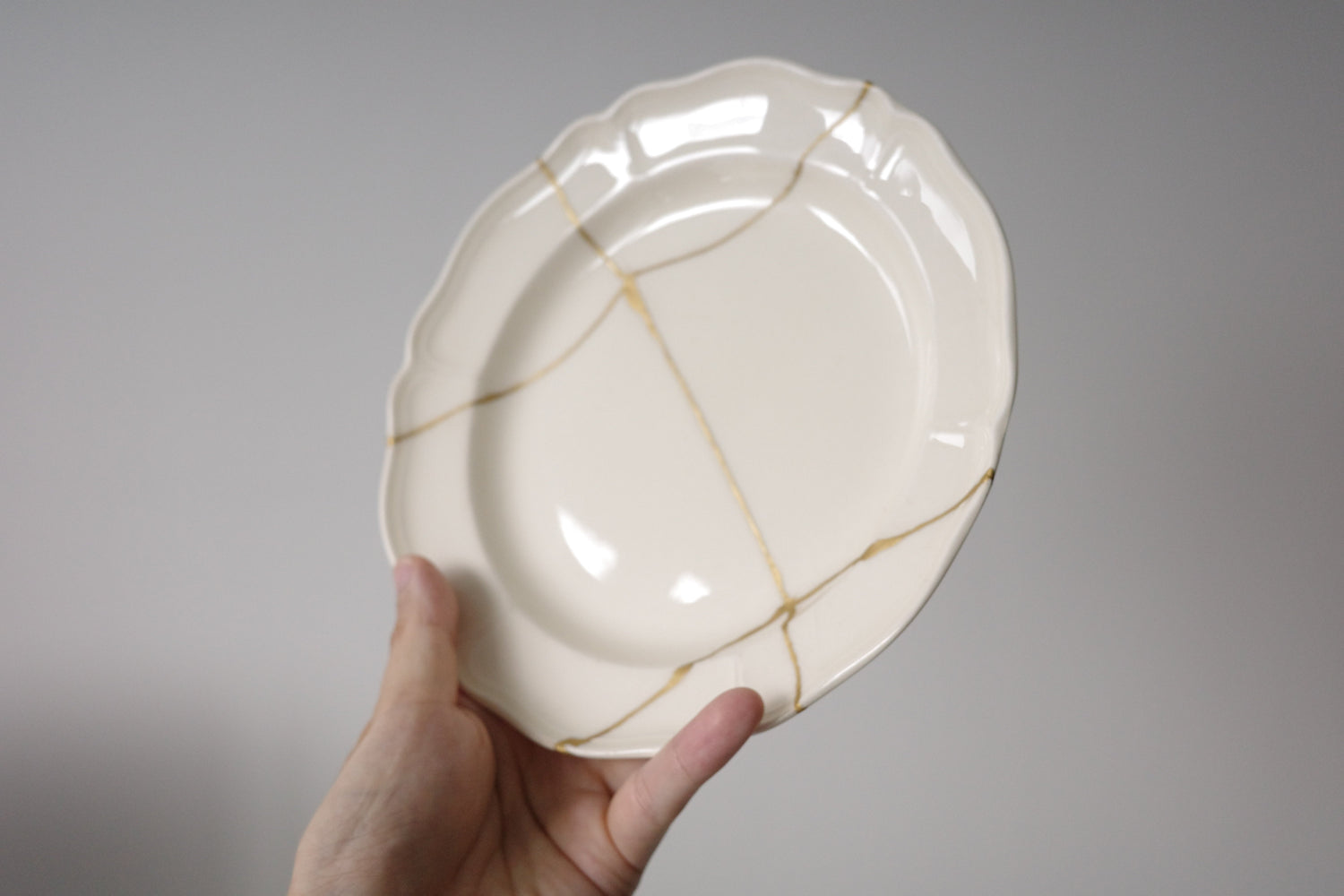

Kintsugi, the Japanese craft known for repairing vessels, currently comes in two main types. One is the traditional method called "authentic urushi kintsugi." The other is "simplified kintsugi," which emerged to meet modern demands.
For those wondering, "I want to try kintsugi, but which should I start with?" or "I want to repair a vessel, but which method should I choose?" This article explains the differences between simplified kintsugi and authentic urushi kintsugi in an easy-to-understand way for beginners.
Differences Between Authentic Urushi Kintsugi and Simplified Kintsugi
Kintsugi can be divided into two types based on the materials used and the work process:
- Authentic Urushi Kintsugi: Uses urushi lacquer, involves many steps, and takes about 1 month to complete
- Simplified Kintsugi: Does not use urushi, uses synthetic resin instead, and can be completed in about 1 day
Two Types of Kintsugi: Authentic Urushi and Simplified
Kintsugi traditionally uses "urushi," a natural sap harvested from the urushi tree, to bond and repair vessels. This traditional method is called "authentic urushi kintsugi," and when people refer to kintsugi, they generally mean this technique.
On the other hand, "simplified kintsugi" is a newer method that has emerged in recent years. It does not use urushi but instead uses synthetic resin adhesives made artificially from petroleum and other materials. This eliminates the need for the urushi curing process. Due to its convenience, it is widely used in one-day workshops and beginner kits.
*Note: There is also an intermediate method called "kan-urushi kintsugi" that combines synthetic resin and urushi. However, this article focuses on the two main types: authentic urushi kintsugi and simplified kintsugi.
The Biggest Difference Is Urushi
The biggest difference between authentic urushi kintsugi and simplified kintsugi is whether urushi is used.
In authentic urushi kintsugi, urushi is used in almost every step, from bonding broken pieces to the final finish. Specifically, "raw urushi"—sap harvested from the tree with only impurities like debris removed—is processed according to its intended use. It may be used as-is, mixed with powder or pigments to create adhesives or fillers for chips, or applied as a base for sprinkling gold powder.
On the other hand, simplified kintsugi does not use urushi at all. Since urushi takes a long time to cure, repairing a single vessel takes about one month. Instead, simplified kintsugi uses synthetic resin, which cures quickly and allows completion in about one day. With fewer steps and easier handling, even beginners can try it with ease.

Quick Comparison of Other Differences
In addition to urushi and work processes, here are other key differences. Details for each are explained in Chapter 3.
|
Comparison |
Authentic Urushi Kintsugi |
Simplified Kintsugi |
|
Main Materials |
Natural materials such as raw urushi and pure gold powder |
Synthetic resin and substitute gold powder |
|
Cost Estimate |
Higher (kits over ¥10,000) |
Lower (kits around ¥5,000) |
|
Time Required |
About 1 month |
About 1 day |
|
Safety |
Risk of urushi rash |
No risk of urushi rash |
|
Finish |
Uses pure gold powder, applied evenly More elegant finish |
Uses substitute gold powder or brass powder, difficult to apply evenly Results may vary |
|
Durability |
Highly durable and heat-resistant Gold finish resists tarnishing |
Nearly equivalent to authentic urushi kintsugi Gold finish prone to tarnishing |
|
Other |
Requires an urushi curing chamber (muro) |
Authentic Urushi Kintsugi vs. Simplified Kintsugi: Pros and Cons
Easy to Get Started! Pros and Cons of Simplified Kintsugi
Pros
Quick and Fast-Drying
Simplified kintsugi uses synthetic resin to bond cracks and chips. The drying time is short, and in most cases, the work can be completed in one day.
No Risk of Rash or Allergies
Since simplified kintsugi does not use urushi, there is no risk of urushi rash during the process. It is suitable for those with sensitive skin or those who want to try it with children.
Lower Cost
Compared to authentic urushi kintsugi, simplified kintsugi materials are relatively inexpensive. Kits for home use cost around ¥5,000, and one-day workshops range from ¥6,000 to ¥8,000, making it more accessible than traditional kintsugi.
Cons
Finish and Texture Are Inferior to Authentic Urushi Kintsugi
In simplified kintsugi, the finish is achieved by painting a mixture of substitute gold powder and resin with a brush. Compared to authentic urushi kintsugi, there tends to be more variation in gloss and texture uniformity. With careful application, a beautiful finish is possible, but beginners may experience unevenness or bumps until they get used to handling the brush.
Durability and Tarnishing
The synthetic resin used in simplified kintsugi is strong and durable. However, substitute gold powders such as brass (a mixture of copper and zinc) tend to tarnish more easily than pure gold and may peel over time.
Not Recommended for Tableware Use
The synthetic resin used in simplified kintsugi often does not comply with food safety standards and is not suitable for repairing tableware. It is recommended for decorative or display purposes only.
>> Simplified Kintsugi Is Recommended For:
-
Those who want to repair vessels quickly and easily
-
Those who want to use repaired items for decoration or display
-
Those who want to avoid the risk of urushi rash or allergies

For Authentic Kintsugi! Pros and Cons of Authentic Urushi Kintsugi
Pros
High Durability
Once cured, urushi has excellent durability, insulation, and antiseptic properties. Additionally, joints finished with pure gold powder resist tarnishing and last long, so with careful handling, the vessel can be safely used as everyday tableware.
Beautiful Finish
Traditional authentic urushi kintsugi has a completely different finishing process from simplified kintsugi. Also, because pure gold powder is used for the finish, it achieves a deep, lustrous glow and resists tarnishing compared to substitute gold powder.
Food-Safe for Tableware
Authentic urushi kintsugi uses only naturally derived materials such as urushi, wheat flour, and wood powder. Since it contains no chemical substances, the repaired vessel can be safely used as tableware.
Cons
Time-Consuming
The biggest difference between authentic urushi kintsugi and simplified kintsugi is the time required for repair. The urushi used in authentic urushi kintsugi must be dried over several days to weeks while maintaining consistent humidity and temperature. The number of days to completion varies depending on the vessel's condition, but expect it to take 1 to 3 months.
Risk of Urushi Rash and Allergies
Urushi can cause "urushi rash" if it comes into contact with the skin while still in liquid form before curing. Urushi rash is a type of dermatitis caused by urushiol, the main component of urushi, and can cause redness and itching similar to an allergic reaction. Symptoms vary by individual, so precautions such as wearing gloves are necessary when handling urushi.
Higher Cost
Authentic urushi kintsugi uses raw urushi and pure gold powder, making materials more expensive than simplified kintsugi. Kits for home use cost around ¥10,000. If you attend classes, enrollment fees, tool costs, and tuition can add up to tens of thousands of yen.
>> Authentic Urushi Kintsugi Is Recommended For:
-
Those who want to learn traditional kintsugi techniques
-
Those who want to safely use repaired vessels as tableware
-
Those who want to continue kintsugi seriously as a hobby

Detailed Comparison of Authentic Urushi Kintsugi and Simplified Kintsugi
Differences in Materials and Process
Because authentic urushi kintsugi and simplified kintsugi use different materials, there are also significant differences in the process.
In simplified kintsugi, broken vessels are bonded with synthetic resin, and chipped areas are also filled with synthetic resin. After curing, the surface is smoothed with sandpaper, and finally, a paint made of substitute gold powder mixed with resin is applied with a brush. This simple method can be completed in about one day.
On the other hand, authentic urushi kintsugi follows these repair steps:
-
Bonding: Bond cracks with "mugi-urushi," a mixture of raw urushi and wheat flour (cures in about 1 week)
-
Filling chips: Fill small holes and chips with "sabi-urushi," a mixture of tonoko powder and raw urushi (cures in about 1 day)
-
Middle coating: Apply black lacquer "kuro-urushi," let it cure, and smooth the surface with sandpaper. Repeat this 2–3 times. (About 3 days)
-
Finishing: Apply red lacquer "bengara-urushi," then sprinkle gold powder on top to complete
Natural urushi cures slowly in response to humidity and temperature, so the entire process takes about one month.
As you can see, simplified kintsugi uses easy-to-handle materials instead of urushi and finishes in a short time. In contrast, authentic urushi kintsugi involves repeatedly applying and curing urushi, requiring more steps, effort, and time.
Differences in Time Required
Since simplified kintsugi does not use urushi and instead uses faster-curing synthetic resin, the working time to repair one vessel is about 3 hours, with full completion in about 1 day. In contrast, authentic urushi kintsugi requires repeatedly applying and drying urushi. Therefore, the working time is 8–10 hours, but including curing time, the entire process takes about 1 to 3 months.
Differences in Cost
|
Item |
Simplified Kintsugi |
Authentic Urushi Kintsugi |
|
Kit Price |
Around ¥5,000 |
Around ¥10,000 |
|
Workshop / Class |
¥6,000–8,000 |
¥10,000–30,000 Enrollment fee, tools, and class fees |
|
Finish |
Substitute gold powder |
Pure gold powder |
There is a significant cost difference between simplified kintsugi and authentic urushi kintsugi. The main reason is the difference in finishing materials. Simplified kintsugi often uses substitute gold powders such as brass (a mixture of copper and zinc), which keeps costs relatively low. Authentic urushi kintsugi typically uses pure gold powder, which increases the price.
However, authentic urushi kintsugi does not necessarily require pure gold powder. You can use substitute gold powder for practice or silver powder for a different aesthetic. It is possible to adjust flexibly based on your purpose and budget.

About Safety
Common concerns with kintsugi are urushi rash and the safety of using repaired items as tableware.
Urushi Rash
Since authentic urushi kintsugi uses urushi in most steps, it is essential to wear gloves during work and be careful not to let urushi touch the skin directly. If contact occurs, washing it off immediately usually prevents major problems, but susceptibility to rash varies by individual. Therefore, it is safest to work in a way that minimizes urushi contact. Simplified kintsugi does not use urushi, so there is no risk of urushi rash.
Food Safety for Tableware Use
Authentic urushi kintsugi uses only naturally derived materials, so repaired vessels can be safely used as tableware. On the other hand, the synthetic resin used in simplified kintsugi is not guaranteed safe for tableware use. Therefore, for repairs to areas that will contact food or the mouth, authentic urushi kintsugi is recommended.
Appearance and Durability
Because simplified kintsugi is relatively inexpensive, some may worry, "Is the appearance or durability inferior to authentic urushi kintsugi?" In fact, while there can be differences in appearance, durability is not significantly different with careful handling.
Appearance
In authentic urushi kintsugi, gold powder is sprinkled evenly and densely during the finishing stage, resulting in a lustrous, elegant finish. In simplified kintsugi, the mainstream finish involves painting a gold-colored mixture of gold powder and resin with a brush. Compared to sprinkling gold powder as in authentic urushi kintsugi, this method tends to produce more unevenness, and the gold grain and gloss may appear somewhat coarse. Also, if you are not used to handling a fine brush, lines tend to become thick. However, with careful work, a finish close to authentic urushi kintsugi is possible. That said, it still cannot match the delicate luster of authentic urushi kintsugi.
Durability
Simplified kintsugi uses synthetic resin, so the bonded joints are strong. However, there is a risk that the gold finish may peel or tarnish. This is because substitute gold powders such as brass are used instead of pure gold powder, and the finishing method is simpler.
On the other hand, urushi, the main material in authentic urushi kintsugi, is sensitive to high temperatures and prolonged water exposure, so care is needed. Urushi can be damaged if temperatures exceed its heat tolerance. Therefore, use in microwaves, ovens, or over open flame is not allowed. Also, prolonged soaking in water can damage urushi and cause joints to fail. Therefore, vessels that hold water for long periods, such as vases, are not suitable for repair with authentic urushi kintsugi.
How to Choose Between Authentic Urushi Kintsugi and Simplified Kintsugi
Two Key Points to Know Before Starting
Both authentic urushi kintsugi and simplified kintsugi have their own appeal and considerations. Many people wonder, "Which should I choose?" We recommend considering the following two points to choose the kintsugi method that suits you best.
-
Whether you prioritize safety for tableware use
Many people want to repair cherished tableware or items with sentimental value through kintsugi. If you are thinking, "I want to continue using this at the table for a long time," prioritizing material safety is recommended. Choose based on whether the repair materials are safe to come into contact with your mouth.
-
How much urushi rash risk you can tolerate
The risk of urushi rash is the biggest concern with authentic urushi kintsugi. Even with caution, small amounts of urushi may get on your hands, or you may unknowingly touch your skin and develop a rash. Since it cannot be completely prevented, those with sensitive skin or those who use their hands for work should weigh this factor carefully.
For Everyday Tableware Use, "Authentic Urushi Kintsugi" Is Recommended
If you plan to continue using the vessel as tableware, repair with authentic urushi kintsugi, which uses only natural materials, is recommended. Since it will repeatedly come into contact with your mouth, materials that are safe to use are preferable.
For Display or Photography, "Simplified Kintsugi" Is Sufficient
For vessels that will not touch your mouth or will be displayed as interior decoration, simplified kintsugi is sufficient. It is quick to complete, and there is no risk of urushi rash. It is recommended for those who want to enjoy the beauty of kintsugi easily.
For Cherished Vessels You Want to Use for Years, "Authentic Urushi Kintsugi" Is Recommended
If you want to repair a cherished vessel with kintsugi and continue using it for years, authentic urushi kintsugi is recommended. It takes time and effort, but by slowly working through each step and facing your vessel, your attachment to it may deepen even further.
Recommended Kintsugi Kits for Beginners
If you want to repair a cherished vessel with kintsugi and continue using it for years, authentic urushi kintsugi is recommended. It takes time and effort, but by slowly working through each step and facing your vessel, your attachment to it may deepen even further.
Easy-to-Start "Simplified Kintsugi" Kits
Kintsugi can be easily started at home, and many beginner kits are available through online shopping. Here we introduce recommended kits for both simplified kintsugi and authentic urushi kintsugi.

Source: Amazon
-
KIJIMATSU
Price: ¥5,980 (Amazon)
Finish: Brass powder / Bonding: Synthetic resin
The KIJIMATSU simplified kintsugi set is a popular bestseller on Amazon and Rakuten. It uses brass powder for the finish and includes a beginner's kintsugi manual. Recommended for those who want to try it casually and quickly at home first.
"Authentic Urushi Kintsugi" Kits for Serious Practitioners

Source: Amazon
-
Tsugu Kit
Price: ¥9,980 (Amazon)
Finish: Gold powder / Bonding: Natural urushi
This kintsugi kit is from "Tsugu Tsugu," a Tokyo kintsugi workshop. It does not use turpentine, which requires careful handling at home, making it safe for households with children or for indoor work. In addition to paper instructions, YouTube videos are available to guide you through the process, so even beginners can proceed without confusion.

Source: chimahaga.com
-
Chimahaga
Price: ¥12,900 (Official website chimahaga.com)
Finish: Gold powder / Bonding: Natural urushi
This kintsugi kit is sold by "Chimahaga," a kintsugi artist based in Kobe. Purchasers can ask the kintsugi artist questions if they encounter any difficulties. Since you can get direct advice from an expert when you are unsure about a step, even beginners can work with confidence.
Frequently Asked Questions (FAQ)
Can vessels repaired with kintsugi be used in the microwave or dishwasher?
Avoid using vessels repaired with authentic urushi kintsugi in microwaves or dishwashers. The urushi may exceed its heat tolerance, melt, and damage the vessel. Washing gently with a sponge and neutral detergent is fine, but wiping off water promptly after washing is the key to longevity.
Recently, there are some simplified kintsugi methods that use materials safe for microwave and dishwasher use.
Can a vessel repaired with simplified kintsugi be redone with authentic urushi kintsugi?
Yes, it can be redone. Parts bonded with simplified kintsugi can be loosened by boiling in hot water. If the synthetic resin is carefully removed, the vessel can be repaired with authentic urushi kintsugi. The key is to completely remove the synthetic resin, as any residue on the bonding surface will make it difficult for the urushi to adhere.
Can substitute gold powder achieve a beautiful finish?
Yes, but the texture and color differ from pure gold powder. Substitute gold powder is "a color similar to gold" and keeps costs down, but it may oxidize and tarnish over time. It finishes beautifully enough for display or practice purposes, but for long-lasting shine, pure gold powder is recommended.
How can I make my kintsugi finish last longer?
By keeping these five points in mind, your finish will last much longer:
-
Wash gently with a sponge
-
Do not soak in water for long periods
-
Wipe off moisture immediately after washing
-
Avoid high temperatures such as microwaves, dishwashers, and open flame
-
Handle carefully to avoid rubbing the gold parts hard

Find the Kintsugi That Suits You
There are two types of kintsugi methods—authentic urushi kintsugi and simplified kintsugi—but both share the same sentiment: "making broken things usable again." If you prioritize convenience and safety during work, choose simplified kintsugi. If you seek the beauty of the finish and the peace of mind for long-term use, choose authentic urushi kintsugi. Kintsugi is not just a repair; it is also time spent facing your vessel and yourself. Instead of ending things at the moment of breaking, enjoy the extra effort of "continuing the sentiment."


Leave a comment
This site is protected by hCaptcha and the hCaptcha Privacy Policy and Terms of Service apply.